What is A383 aluminum and when should you use it?
A383 is a high-silicon aluminum casting alloy engineered for reliable die filling of thin walls and intricate features under high-pressure die casting (HPDC). Compared with general-purpose grades, A383 offers excellent fluidity and pressure tightness with a practical balance of strength and cost.
Choose it when your part has long flow lengths, 1.0–2.5 mm walls, sharp turns, or closely spaced ribs—especially for housings, covers, brackets, and decorative components that must paint well and assemble consistently.
Use A383 if:
- The gating must push metal through thin or tortuous sections.
- You want good cosmetic finish after powder coat/paint.
- Dimensional stability and repeatable die fill outrank maximum ductility.
Avoid A383 if your application demands very high elongation or marine-grade corrosion resistance—those cases often favor A380 or wrought solutions.
A383 chemical composition (as-cast)
Typical (mass %) windows used for HPDC production. Exact limits follow your target standard and melt specs.
| Si | Cu | Mg | Zn | Mn | Ni | Fe | Sn | Al |
|---|---|---|---|---|---|---|---|---|
| 9.5–12.0 | 1.5–3.5 | ≤0.3 | ≤1.0 | ≤0.5 | ≤0.5 | 0.6–1.3 | ≤0.3 | Balance |
Notes:
- Higher Si boosts fluidity and lowers solidification shrinkage (good for thin walls).
- Cu contributes to strength/hardness but can slightly reduce corrosion resistance.
- Control of Fe phase shape (via Sr/Be modifiers & melt practice) helps reduce die soldering and improves surface finish.
A383 mechanical properties (room temperature, as-cast)
Representative values for pressure die-cast A383 with standard process controls.
| Property | Typical value |
|---|---|
| Ultimate tensile strength | 300–330 MPa |
| Yield strength (0.2% proof) | 150–170 MPa |
| Elongation | 1.5–3.0% |
| Brinell hardness | ~85–95 HB |
| Fatigue strength (R=−1) | ~90–100 MPa |
Expect property variation with wall thickness, gate velocity, vacuum level, melt cleanliness, and localized pores. Critical-strength features should be located away from runners, ingates, and thick-to-thin transitions.
Physical properties and casting behavior of A383
- Density: ~2.73 g/cm³
- Thermal conductivity: ~120–150 W/m·K
- Electrical conductivity: ~23–26 % IACS
- Linear shrinkage (HPDC): ~0.6–0.9% (geometry-dependent)
- Fluidity & fill: Excellent for thin sections and long flow paths; tolerant of higher gate speeds and moderate die temperatures.
- Pressure tightness: Good; improves with vacuum-assist and proper overflow design.
- Surface quality: Typically good cosmetic grade; Fe control and die lube selection reduce soldering and flow lines.
Is A383 heat-treatable or surface-treatable?
A383 is generally not heat-treated for strength in HPDC (T5/T6 is avoided because pores can blister and dimensional drift can occur). However, two practical conditions are common:
- Low-temperature artificial aging / stress relief may be specified to stabilize dimensions on precision components; it should be validated on first-article parts to avoid paint/powder defects.
- Surface finishing: A383 accepts powder coating, liquid paint, and e-coat well when pretreatment is tuned for die-cast aluminum. For robust paint-line performance, we typically recommend clean → alkaline etch (light) → conversion (zirconium or phosphate). If cosmetic grade is critical, pair finishing with vacuum casting, controlled Fe, and CT-based porosity zoning.
A383 vs A380 — which alloy fits thin-wall and complex parts better?
- Thin-wall fill & long flow: A383 is usually superior thanks to higher Si; it allows 1.0–2.0 mm ribs/webs with fewer short shots at similar die temperatures.
- Ductility & corrosion: A380 has a slight edge in elongation and often in salt-spray performance.
- Cosmetics & paint: Both coat well; A383 tends to show fewer knit lines in thin sections if melt quality is high.
- Machinability: Similar overall; A383’s finer eutectic can leave smoother drilled/tapped features on thin bosses.
- Sealing: A383 can reach good pressure tightness with vacuum-assist; for critical face seals, consider localized resin impregnation or redesign to O-ring grooves.
Quick rule: If your design is thin/complex with long flow and cosmetic demands, start with A383. If it’s thicker, load-bearing, or corrosion-sensitive, start with A380 (or qualify both).
What is A383 equivalent to in other standards?
A383 aligns closely with these naming systems (verify chemistry/mech with your spec before ordering):
- JIS: ADC12
- ASTM/SAE: A383 (sometimes A383.0)
- EN/ISO: EN AC-46000 family (alloyed to similar intent)
- China (GB/T): ZL102 / YL113 class (foundry-specific tuning)
These are cross-references, not perfect chemical clones—purchase to the target standard and melt range written on your PO.
How to design for A383 die casting (thin walls, ribs, bosses)
- Walls: 1.5–2.5 mm is a robust target; 1.0–1.2 mm is feasible with high gate velocity, short fill time, vacuum, and warm dies.
- Ribs: Thickness 0.6–0.8× adjacent wall; fillets ≥0.25× wall; avoid abrupt thick-to-thin jumps.
- Bosses: Core with draft; keep boss OD ≤2.5× thread size; add base pads and gussets to spread load.
- Gating/overflow: Gate into thickest region, run metal across the parting to purge air, and place generous overflows at knit-line zones.
- Cooling & vents: Map hot spots with thermal simulation; add local cooling and vent pins to reduce porosity at sealing faces.
- Datum strategy: Put primary datums on stable pads near the gate-fill front; avoid thin webs as functional datums.
Machining, sealing, and dimensional control for A383
A383 machines cleanly with standard carbide tools. For thin bosses and sealing faces, stability matters more than raw cutting speed:
- Cutting practice: Use sharp positive-rake inserts, moderate chip-loads, and flood coolant to limit heat. Break heavy roughing into multiple light passes to minimize spring-back and edge crumble on thin walls. Ream/tap with short projection to reduce run-out.
- Sealing strategies: For face seals on thin castings, design for O-ring grooves where possible. If a flat-face seal is unavoidable, combine vacuum-assist, smooth metal flow into the region, and CT-guided impregnation only where the CT shows interconnected pores.
- Dimensional control: Establish a first-shot validation loop (die thermal map → cavity balance check → capability run → SPC). Expect a small elastic recovery on thin ribs; compensate in the die or in the machining fixture. Maintain R&R-qualified gaging for critical datums and thread gauges for tapped holes.
Quality control: how do we verify A383 material and properties?
Our typical PPAP/FAI kit for A383 includes:
- Spectrochemical analysis of each melt lot to your standard.
- Melt quality checks (degassing, hydrogen/porosity indicators, inclusion control).
- CT scanning / X-ray on first articles and per control plan to verify porosity class and sealing zones.
- Mechanical sampling per spec (tensile, HB).
- Dimensional reports (CMM + functional gauges) with GR&R evidence.
- Paint/finish tests if required (adhesion, salt-spray on coated coupons).
A383 applications and part examples
- Electronics & lighting: heat-dissipating housings, LED driver covers, bezels.
- Automotive: gearbox/actuator covers, brackets, shift components, interior structural carriers.
- Industrial equipment: pump/valve bodies (with localized impregnation), sensor enclosures.
- Consumer products: appliance frames, hand-tool housings, decorative trim.
Buyer’s guide: does A383 reduce total cost vs alternatives?
A383 can lower total cost when:
- Tooling must support thin walls/long flow, cutting part weight without scrap.
- Cosmetic yield is critical (fewer short-shots/knit-lines at equal process windows).
- You can avoid secondary welding/brazing by filling thin ribs/bosses in one shot.
- Dimensional stability out of the die reduces machining stock and cycle time.
A380 or other alloys may be more economical when:
- Parts are thicker, load-bearing, or in aggressive outdoor exposure.
- You require elongation >3–4% or marine-grade corrosion behavior.
- You plan post-cast heat treatments for strength (HPDC not recommended).
Frequently asked questions
Is A383 the same as ADC12?
They are cross-standard equivalents with the same intent; chemistry windows and impurity caps can differ by region and supplier. Buy to the standard on your PO.
What minimum wall can I target?
Robust designs use 1.5–2.5 mm; 1.0–1.2 mm is feasible with vacuum, high gate speed, and tuned die temperatures. Validate by simulation + short capability runs.
Can A383 be anodized?
Decorative anodize is not recommended. For appearance and corrosion control, powder/e-coat with proper pretreatment is the proven route.
How do I pass paint line consistently?
Control Fe and porosity (vacuum-assist, balanced fill, overflow purge), keep surface free of pulls/laps, and use a zirconium or phosphate conversion prior to powder/e-coat.
Need a reliable supplier to build your A383 aluminum die-cast parts?
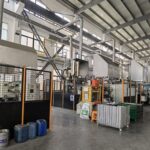
Yongzhu Casting has 20+ years in HPDC, from thin-wall housings to complex brackets. We’ll review your CAD, flag risk points (gates, vents, draft, sealing flats), and return a practical quote and lead time.
- 800–2000-ton presses, vacuum die casting available
- In-house machining & finishing, leak/pressure testing
- Consistent QC: spectrometer alloy check, CT/fixtures, CMM, full lot traceability
Send prints to yongzhucasting@gmail.com for a no-nonsense DFM review and quotation.