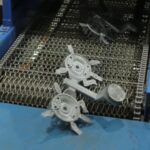
Cast aluminum is made by melting aluminum and filling a mold, which enables complex shapes at scale but can introduce defects (like porosity) that reduce strength consistency. Forged aluminum is formed by compressing solid metal into shape, producing a denser structure and more consistent mechanical performance—especially for fatigue and impact—at the cost of design freedom and more machining.
If your part needs maximum reliability under repeated loads, forging is usually the safer choice. If your part needs complex geometry, near-net shape, and cost efficiency in volume, casting is often the better fit.
Cast Aluminum vs Forged Aluminum
| Topic | Cast Aluminum | Forged Aluminum | What it means for buyers/engineers |
|---|---|---|---|
| How it’s made | Molten metal fills a mold and solidifies | Solid metal is pressed/hammered into shape | Casting excels at shape freedom; forging excels at integrity |
| Typical shapes | Complex, thin-wall features, ribs, internal details (process-dependent) | Simpler external geometry; limited undercuts; usually more machining | If geometry drives cost, casting often wins |
| Strength & fatigue | Can be strong, but more variability | Typically higher and more consistent | Forging tends to provide bigger safety margin |
| Porosity risk | Higher (gas/shrinkage depends on process control) | Much lower | Porosity is a common reason cast parts scatter in strength |
| Dimensional control | Good to excellent (process-dependent), may still require machining | Usually requires machining for tight tolerances | Forgings are often “near-shape,” not “net-shape” |
| Tooling cost | Mold/die cost varies; can be high for die casting | Forging dies can be high; press capacity matters | Both have tooling; drivers differ |
| Unit cost drivers | Cycle time, yield, scrap, finishing, machining time | Material utilization, machining time, heat treat, inspection | Compare total landed cost, not only piece price |
| Best for | Complex parts, high volume, cost-sensitive geometry | High-load parts, fatigue/impact risk, consistency | Match method to failure mode and risk tolerance |
Fast Selection Guide
| Your priority | Usually choose | Why |
|---|---|---|
| Complex geometry / integrated features | Casting | Molded features reduce machining and assemblies |
| High fatigue life / impact / reliability | Forging | Lower defect probability + better structural consistency |
| Lowest unit cost at volume (geometry-friendly) | Casting | High throughput, near-net shape potential |
| Tight tolerances on critical interfaces | Either + machining | Process creates shape; machining ensures precision |
| Rapid iterations/prototyping | Depends | Often CNC prototype first, then pick casting/forging for production |
What Is Cast Aluminum?
Casting produces parts by pouring molten aluminum into a mold, allowing it to cool and solidify into the desired shape. Casting is a broad family: the exact capability (surface finish, tolerances, cost) depends on the casting route and tooling.
How casting works (simple process flow)
- Melt aluminum alloy to a controlled temperature range
- Fill the mold (gravity, pressure, or other method depending on process)
- Solidify and cool (this stage strongly affects defects and microstructure)
- Remove the part, trim gates/flash, and perform finishing
- Machine critical interfaces and apply surface treatments as required
What casting is good at
Casting is strong when the design benefits from shape freedom:
- Integrating multiple features (bosses, ribs, brackets) into one part
- Producing complex exterior geometry and detailed forms
- Reducing assemblies (fewer fasteners/welds) by “casting in” functions
- Achieving cost efficiency when the process is matched to volume and design
What can go wrong in casting
Castings can contain defect types that matter for performance:
- Gas porosity (entrapped gas creating small voids)
- Shrinkage porosity (voids from solidification shrinkage)
- Inclusions (non-metallic particles)
- Cold shuts / misruns (incomplete fusion/filling)
Not every casting has these problems, and many cast parts are extremely reliable when properly designed and controlled. The key engineering reality is that defects increase the likelihood of strength scatter—especially under fatigue—so quality control and process capability become central to specification.
What Is Forged Aluminum?
Forging shapes aluminum while it is solid, using compressive force to form the part. The metal is “worked” into shape, commonly followed by heat treatment and machining.
How forging works (what happens to the metal)
A simplified flow:
- Start from billet/slug (or preform)
- Heat to a controlled forming range (or warm/cold for specific cases)
- Apply compressive force in dies to form the shape
- Trim flash and perform heat treatment as specified
- Machine to final dimensions; finish surface as required
Why forging typically performs better
From a buyer/engineer perspective, forging often delivers:
- Higher resistance to crack initiation under cyclic loads (fatigue)
- Better impact toughness in demanding environments
- More predictable mechanical performance part-to-part, batch-to-batch
- Lower risk of internal voids compared with many casting routes
Trade-offs of forging
Forging is not “better at everything.” It trades away:
- Design freedom (undercuts and complex internal geometry are harder)
- Near-net shape capability (often more machining required)
- Tooling/press constraints (part size/shape must suit forging equipment)
Why Does Forged Aluminum Usually Outperform Cast Aluminum?
Microstructure: grain flow vs random structure
In simple terms, forging “works” the metal and tends to create a more continuous structure compared with the more random solidification structure of a casting. This helps performance in failure modes where cracks tend to follow weak paths—especially in fatigue.
Defect probability: porosity and inclusions
Porosity is one of the biggest differences in real-world reliability. Small voids can act like stress concentrators, raising the chance of crack initiation. Forged parts typically have a lower probability of internal voids because the material isn’t created by solidification in a mold cavity.
Property consistency: mean strength vs minimum strength
Two parts can have the same “average” tensile strength on paper yet behave differently in service. Many engineers care more about:
- minimum strength
- fatigue scatter
- defect-driven outliers
Forging often improves consistency, which is valuable when failure risk is expensive.
Mechanical Properties Compared (Strength, Fatigue, Impact, Ductility)
Which properties matter in real design?
- Static strength: one-time overload resistance
- Fatigue strength: resistance under repeated loading (often the real driver)
- Impact toughness: resistance to sudden loads or abuse
- Ductility: tolerance to deformation before fracture
- Stiffness: how much the part deflects (often more geometry-driven than process-driven)
Engineering comparison table (typical trends)
| Property | Cast Aluminum (typical trend) | Forged Aluminum (typical trend) | What it means |
|---|---|---|---|
| Tensile / yield | Can be high (alloy/temper dependent) | Often higher for comparable design targets | Forging can allow higher allowable stress or thinner sections |
| Fatigue resistance | More sensitive to defects/porosity | Typically stronger and more consistent | Forging often preferred for cyclic loading |
| Impact toughness | Can be adequate; depends on alloy/quality | Usually better | Forging tolerates shock and abuse better |
| Ductility | Varies; can be limited if defects present | Often higher | Better resistance to crack propagation |
| Consistency | Depends heavily on process control | Typically tighter scatter | Helps with warranty and safety margins |
Heat treatment and temper matters
A huge source of confusion is comparing “cast” vs “forged” without specifying alloy + temper. The same process can deliver very different strength depending on heat treatment.
If your design depends on strength, always specify:
- alloy designation
- temper condition (or heat treatment requirements)
- required mechanical properties (if applicable to your spec route)
Cost & Manufacturing Efficiency — What Actually Drives Price?
Tooling and setup costs
Both routes have tooling, but the cost drivers differ:
- Casting tooling cost is driven by part complexity, mold design, expected tool life, and throughput requirements.
- Forging tooling cost is driven by part size, die design complexity, material flow considerations, and press capacity.
Tooling should be evaluated across expected volume and product lifecycle, not just as a one-time number.
Unit cost drivers (what makes piece price go up)
For casting, common cost drivers include:
- yield (how much metal becomes good parts vs runners/scrap)
- cycle time and machine time
- scrap rate and rework
- machining time for critical features
- finishing requirements
For forging, common cost drivers include:
- material utilization (buy-to-fly)
- number of forming steps and die sets
- trimming and heat treatment
- machining time (often significant)
- inspection/NDT requirements
Lead time considerations
A practical workflow many buyers use:
- CNC prototype or soft tooling for early validation
- lock the method (cast vs forged) once loads, geometry, and volume are clear
- build production tooling and validate process capability
Design Freedom vs Performance — How to Choose the Right Route
Choose casting when…
Casting is typically a good match if:
- geometry is complex and would be expensive to machine from solid
- you want to integrate multiple functions into one component
- production volume favors mold-based manufacturing economics
- the part’s failure mode is not fatigue-dominated (or fatigue loads are modest and controllable)
Choose forging when…
Forging is typically a good match if:
- loads are high, cyclic, or safety margin is tight
- reliability and consistency are more important than geometry freedom
- impact abuse or harsh service conditions are expected
- you want to reduce the risk of defect-driven failure
A short “hybrid” note
In some designs, the best outcome is achieved when a part is formed close to shape and then machined to final precision. The key decision is still the same: match the process to the risk profile and the geometry.
Common Aluminum Alloys Used in Casting vs Forging
Typical casting alloy direction (why some alloys cast better)
Many casting-friendly alloys are formulated to improve:
- fluidity and mold filling behavior
- solidification characteristics
- defect resistance under controlled conditions
Casting alloy choice often prioritizes manufacturability first, then properties via heat treatment and design.
Typical forging alloy direction (why some alloys forge better)
Forging-friendly alloys tend to emphasize:
- strength-ductility balance
- forming behavior under deformation
- heat-treat response for high performance targets
How to specify alloy + temper correctly
When sending an RFQ or writing a PO, include:
- alloy designation
- temper/heat treatment requirement
- critical mechanical property requirement (if needed)
- dimensional tolerances for critical features
- inspection expectations (visual, dimensional, NDT if applicable)
Quality Risks & Inspection — How Buyers Control Variability
What to inspect for cast parts
Common buyer controls include:
- dimensional inspection of critical interfaces
- surface and defect criteria (cosmetic vs functional zones)
- leak testing for pressure-retaining parts (if applicable)
- X-ray/CT or other NDT for high-risk components (when justified)
The goal is to manage defect risk in the zones that matter.
What to inspect for forged parts
Forging controls often focus on:
- mechanical property certification as required
- dimensional inspection after machining
- NDT for critical applications (depending on industry/spec)
Copy-paste PO / drawing notes (example spec block)
You can paste and edit the following as a starting point:
Manufacturing Method & Material
- Part manufacturing method: [CAST / FORGED] aluminum
- Alloy: [e.g., ___]
- Temper / heat treatment: [e.g., ___]
- Mechanical requirements: [if applicable, specify yield/tensile/elongation or standard]
Quality & Inspection
- Critical dimensions: 100% inspection / CMM as agreed
- Surface condition: [define cosmetic vs functional surfaces]
- Defects: no cracks; porosity/void acceptance per agreed criteria in functional zones
- NDT (if required): [X-ray / dye penetrant / other], sampling plan: [___]
Finish
- Surface finish: [anodize / powder coat / plating / none], specification: [___]
- Masking requirements: [threads/sealing surfaces/grounding areas]
Surface Finish & Post-Processing What Changes After Forming?
Machining allowance expectations
- Cast parts may allow more near-net features, but critical interfaces still often need machining.
- Forged parts frequently require machining to reach final geometry and tolerances.
Finishes and compatibility notes
Your finish selection should consider:
- corrosion environment
- wear/appearance needs
- dimensional impact of coatings
- masking requirements for sealing, threads, or grounding areas
FAQ
Is forged aluminum stronger than cast aluminum?
Often yes—especially when comparing parts designed for high loads and when consistency/fatigue resistance matters. But alloy and temper can change the outcome, so compare based on specified material condition, not process name alone.
Is cast aluminum always brittle?
No. Many cast alloys are engineered for good performance, and well-controlled casting can produce durable parts. Brittleness is usually a result of alloy choice, heat treatment, and defect control—not simply “because it’s cast.”
Does casting porosity always reduce strength?
Porosity increases risk, especially for fatigue. Some porosity may be acceptable in non-critical zones. The key is specifying defect acceptance and inspection based on functional areas.
Which is cheaper: cast or forged aluminum?
It depends on geometry, volume, machining, and quality requirements. Casting can be cheaper for complex shapes and high volume. Forging can be cost-effective when performance prevents failures, reduces weight, or simplifies downstream reliability needs.
Can cast aluminum be heat treated to match forged performance?
Heat treatment can significantly improve cast properties, but it can’t fully remove defect-driven variability. If your design is fatigue-dominated, forging often still provides better consistency.
Conclusion
Choose cast aluminum when geometry and cost efficiency in volume drive the decision, and you can specify the right quality controls. Choose forged aluminum when high loads, fatigue, impact, and reliability are the priority, and you want tighter mechanical performance consistency. The best choice is the one aligned with your part’s failure mode, tolerances, volume, and risk profile.
If you want, you can send the part’s application, expected loads (or failure concern), and target annual volume, and I can help you translate that into a clear RFQ/PO spec and process route recommendation.