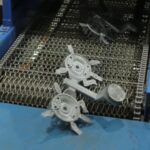
Zamak (zinc) die casting is the fastest way to get crisp, cosmetic metal parts at scale. At YongZhu Casting we design the die, build the tooling, cast, polish, plate (mirror chrome or satin nickel), assemble and ship—so buyers get one accountable partner from DFM to finished goods.
Why Zamak for customer-facing metal parts?
Zamak alloys (2/3/4/5/7) fill thin ribs and sharp details extremely well, giving you tight dimensional repeatability and class-A surfaces ready for plating. Compared with aluminum, Zamak can achieve a deeper gloss and a more uniform chrome—ideal for handles, knobs, logos, trim, furniture and appliance hardware, bathroom accessories, locks, latches and decorative components.
What lead times, MOQs, and price drivers should buyers expect?
The figures below are planning guides; we’ll quote firm numbers from your CAD and finish spec.
| Commercial item | Typical range (guide) | Notes |
|---|---|---|
| Prototype tool | 3–5 weeks | For cosmetic/fit checks; single cavity |
| Production tool | 5–9 weeks | Single/multi-cavity; family tools possible |
| First-off samples | +1–2 weeks after T0 | Includes polish/plating sign-off |
| Pilot run | 500–3,000 pcs | Great for rack development & PPAP |
| Mass production | 3k–100k+ pcs per order | Cycle-time balanced to plating throughput |
Main cost levers
- Tooling complexity (cavities, lifters, slides), expected yield, and target polish class
- Plating stack (Cu/Ni/Cr thickness, satin vs mirror), masking and rack density
- Packaging standard (bag/foam/blister), export carton, drop-test requirement
- CTQs that drive slower cycle or added inspection/sorting
Which Zamak alloy should I choose?
Use this quick selector; we’ll confirm during DFM.
| Alloy | Strength & elongation | Fluidity / thin-wall fill | Corrosion / platability | Typical uses |
|---|---|---|---|---|
| Zamak 3 (ACuZn35) | Balanced strength/ductility | Excellent | Excellent for Cu/Ni/Cr | Most decorative chrome parts, general hardware |
| Zamak 5 | Higher strength than Zamak 3 | Very good | Excellent | Hinges, locks, functional hardware with load |
| Zamak 2 | Highest strength; age-hardens | Good | Good | High-load small parts, gears, levers |
| Zamak 7 | Extra low impurities; very fluid | Best | Excellent | Ultra-thin detail, fine logos, micro features |
| Zamak 4 | (Regional) balance of 3/5 | Very good | Excellent | Where spec calls out ZA-4 variants |
Our end-to-end process
- DFM & tooling plan – We review wall transitions, draft, gating, venting, and define polish/plating class and datum strategy.
- Tool build & T0 – Single or multi-cavity steel dies with hot-chamber machines sized for your part.
- Stabilize cosmetics – Trim, deburr, polish to the required class; run rack trials with test coupons.
- Plating or painting – Mirror chrome (Cu/Ni/Cr), satin nickel, nickel-only, or powder/wet paint.
- Mass production – SPC on critical dimensions, cosmetic sorting per visual acceptance.
- QA & logistics – FAI/PPAP on request; export packing with humidity control and drop-test as needed.
Core capabilities
- Cavity strategy: single, multi-cavity, and family tools
- Tight details: thin-wall ribs, crisp logos, knurls, knops, fillets down to cosmetic radii
- Vacuum assist: used where porosity risk overlaps cosmetics or CTQs
- Secondary ops: tapping, drilling, light machining, sub-assembly, adhesive bonding
Is Zamak die casting cheaper than CNC machining?
Short answer: for decorative parts above a few hundred pieces, usually yes—because cycle time, polish standardization and plating throughput reduce piece price. CNC can win when demand is very low or the geometry is thick/solid and frequently changing.
| Situation | Choose Zamak die casting | Choose CNC machining |
|---|---|---|
| 2k–50k pcs/year, Class-A chrome/satin | ✅ | |
| < 300 pcs / frequent ECOs | ✅ | |
| Thin-wall or fine logo detail | ✅ | |
| Thick billet-like mass | ✅ |
What surface finishes can I get?
We keep dedicated plating partners and develop racks on test panels before mass production.
| Finish | Typical stack / thickness | Look & feel | Where it shines |
|---|---|---|---|
| Mirror Chrome | Cu + Ni (multi-layer) + Cr | High gloss, deep mirror | Bathroom & kitchen hardware, premium furniture trim |
| Satin Nickel / Brushed | Cu + Ni (satin) | Soft sheen, fingerprint-friendly | Appliance pulls, interior auto trim, devices |
| Nickel-only | Ni | Warm silver tone | Cost-optimized decor |
| Powder / Wet Paint | per color | Opaque color; structured options | Brand colorways, corrosion topcoat |
Visual acceptance criteria (excerpt)
- Show faces: high-gloss bands with spec’d DOIs; scratch/dent ≤ defined length/depth
- Non-show faces: witness marks permitted within zones; rack marks allowed where hidden
- Lint, pits, blisters: controlled by AQL and sampling plan agreed at PPAP
Tolerances & quality
| Topic | Typical capability |
|---|---|
| Linear tolerance (as-cast) | ±0.05–0.10 mm per 25 mm (feature-dependent) |
| Hole true position (post-op) | < 0.10–0.20 mm common |
| Surface class | from utility to Class-A polish |
| Documentation | FAI/PPAP levels I–III, GR&R, capability studies |
| NDT | X-ray/CT sampling on request |
| Compliance | RoHS/REACH, material traceability, plating bath controls |
(Final tolerances depend on geometry, tool design, and measurement method.)
Low-volume to mass production—how we bridge
- Prototype/bridge tools for early marketing or fit—same surface class proves out before you scale.
- Family tooling to combine related SKUs when cosmetic zones and cycle allow.
- Ramp plans that sync casting lot size with plating line capacity to keep finishes uniform.
Industries we serve
- Furniture & architectural hardware – pulls, knobs, brackets, trim
- Appliances – handles, control bezels, badges
- Locks & security – escutcheons, levers, housings
- Bath & kitchen – decorative fixtures, holders, hooks
- Consumer devices – brand logos, stands, dress parts
Packaging & logistics
- Export packing with bag/foam/blister, anti-scuff separators, and humidity control
- Drop-tested cartons and pallet patterns for big box or e-commerce channels
- Global shipping to North America, Europe, and APAC with commercial invoices, HS codes, and plating declarations included
RFQ checklist
- 3D CAD + marked show faces and CTQs/datums
- Target finish (mirror chrome / satin nickel / paint) and required salt-spray hours
- Annual volume + order cadence; pilot quantity if needed
- Any PPAP/FAI level, special inspection, or NDT requirements
- Packaging spec (individual bag, tray, foam, blister) and ship terms
Mini case study
A home-hardware brand switched their appliance pulls from CNC + polish to Zamak 3 die casting with mirror chrome. After we stabilized polish bands and optimized rack density, piece price dropped 38%, plating rejection fell below 0.7%, and the program scaled to 60k pcs/quarter with consistent DOI and gloss across colorways.
Ready to review your part?
Upload your CAD and finish target. We’ll return a DFM with alloy recommendation, draft/polish plan, tooling concept, and a quote that breaks out tooling, piece price by volumes, and plating options—so you can choose the right path from pilot to mass production.